Friday, December 14, 2012

Six Reasons Thread Milling is Better Than Tapping


By Bob Winegard, Application Support and Training

Thread milling surfaced approximately 25 years ago in response to NASA’s need to machine high-quality threaded holes in extremely tough materials such as titanium, Hastelloy and Inconel – a feat not possible with a tap. Over the years, thread milling has and continues to evolve, and manufacturers are now using the process to produce strong, exceptional threads in hardened materials up to 70 Rockwell.

Top six reasons thread milling is better than tapping:

1.  You’ll always achieve a better thread quality with thread milling than tapping.

2.   Depending on your hole size, you can perform tapping either by hand or machine. With thread milling, however, you must always use a machine, which ensures better overall thread consistency. 

3.  Thread milling is a lot easier on your machine tool because it requires much lower cutting forces than tapping.

4. In thread milling, you don’t have to have the hole right on size because the thread mill will cut the hole larger. When people tap, they typically tap the hole larger than necessary because it is easier. However, in doing so, they lose part of the thread and reduce its overall strength.

5. It’s common for smaller taps to break during the tapping process. Upon breaking, you can try to get the tap out of the hole, which can be time consuming, but more often than not, you will need to scrap your part.    

6.  With thread mills, you can create right and left-handed threads using the same tooling.
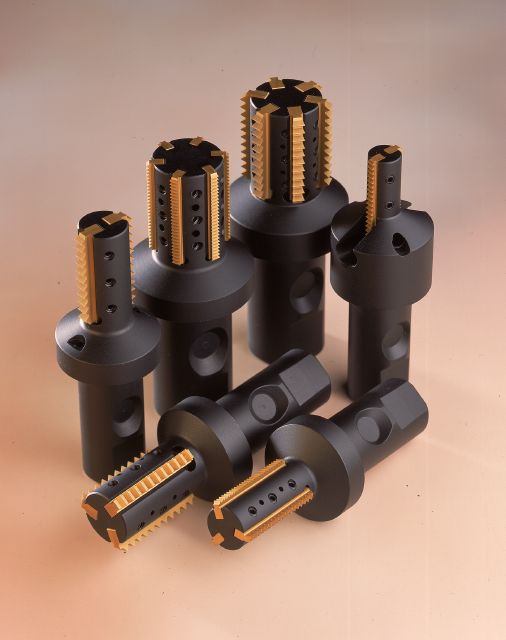

Keep in mind, however, before you can thread mill you must have a machine tool with three-axis capabilities. While most of today’s machines have such abilities, a lot of older equipment does not. You must also consider how deep you need to thread mill because you should not go deeper than one and a half times the diameter of your hole. The reason being is that the longer your milling tool, the more chance you have of experiencing deflection, which can create inaccuracies in the thread.

With thread milling, you have a couple of tooling options from which to choose. You can opt for either a solid carbide or indexable tool. Solid carbide tools are ideal for smaller hole sizes because an indexable tool typically won’t fit in holes that are ” or less in diameter. In terms of cost, solid carbide thread mills are more expensive than indexable designs. With an indexable tool, once you've purchased the thread mill body, the cost of the inserts are more affordable than solid tooling. Indexable tools also have shanks made of steel, which makes them more forgiving than solid carbide tools.     

Lastly, before you go to thread mill, be sure to take advantage of Seco’s Thread Milling Wizard software, which is available via our web site. The software will ask you a series of questions about the type of thread you’re trying to achieve, and based on your responses, it will create a highly effective, tailor-made CNC program for use with your machine tool.

About the Author  
As an integral member of Seco’s dedicated application support and training team, Bob works closely with Seco customers to help them optimize their tool usage and find ways to increase their productivity and reduce costs. Contact Bob at bwinegard@secotools.com.

Monday, November 19, 2012

Let Process Optimization Ensure Your Continuous Growth


By Kurt Nordlund, President

Given today’s extremely competitive manufacturing landscape, shops are spending more time scrutinizing every aspect of their production processes to identify areas of potential improvement, including their cutting tool selections. And this is a good thing because it shows the “good enough” mentality of days past is out and continuous optimization of complete manufacturing processes is in.

Seco works closely with its customers on process optimization.
In the past, shops often overlooked many aspects of the part-production process, having a tendency to focus heavily, or even exclusively, on just the machine tool. They failed at paying equally important attention on complementary technologies such as tooling, software and automation. It’s almost like buying a Ferrari without a high-performance engine and tires.

Consider a shop that purchases a new machine tool with the latest technological advances, but then equips it with tooling used on the shop’s previous machine. Multiple problems can arise from this scenario. At best, the shop will likely be forgoing getting the maximum performance out of its costly new investment, representing lost potential and wasted money. Even worse, the older cutting tools may perform worse in the new machine than they did in the old, and it’s entirely possible to end up with the new process providing results that are inferior to what could previously be obtained.

With the drive for more comprehensive process optimization, shops are relying more heavily on their suppliers. In fact, the dynamics of these relationships have changed and grown into collaborations and partnerships, where both parties work together for mutual support, problem solving and developing total manufacturing solutions. In fact, the process improvement work our Productive and Cost Analysis Team and Component Engineering Tooling Group have done for our customers are great examples of such collaborations.

Utilizing suppliers’ in-depth knowledge of manufacturing technology as a resource allows shops to keep abreast of the latest advancements in manufacturing, as well as understand how those innovations play into process optimization. The end result is that a shop continues to increase its competitive advantages and differentiate itself as a technology leader in the increasingly challenging global market.

However, the responsibility for continuous process optimization should never be placed solely on the shoulders of manufacturing engineers or the shop’s suppliers. For sustainable success, companies must develop and integrate continuous improvement programs that drive and support business development.

Additionally, training – whether provided by shops themselves or by their suppliers – must accompany and further support any type of continuous improvement program. At Seco, our STEP program provides customers with a blend of hands-on training and classroom discussion to help them implement changes within their operations to improve overall productivity. After all, the more knowledge and training people have, the more energized, enthusiastic and motivated they are to offer suggestions and to work together for continuously re-evaluating and re-optimizing manufacturing processes.

Continuous improvement programs may not require fully staffed physical departments, but they do have to strongly encourage and support a company-wide continuous process optimization initiative. At every level of the organization, there must be a true drive to improve. Because in the end, when a manufacturer can be more productive and profitable through better machining practices, they can pass on more savings to their customers and, in turn, gain repeat business. It's a win-win for everybody. 

Relevant Seco Video Links

About the Author
Kurt is the president of Seco Tools Inc. NAFTA, responsible for overseeing the company’s operations in the US, Canada and Mexico. In his spare time, he enjoys spending time with his family, golfing and other outdoor activities. Contact Kurt at knordlund@secotools.com.

Friday, October 26, 2012

Thinking More Positive About Negative Cutters


By Todd Miller, Manager, Rotating Products

At Seco, we are constantly seeking out new ways for our customers to save money and still productively produce quality products. Such commitment has enabled us to continuously add new dimensions to the world of metalcutting where “one size does not fit all.” Consider our brand new take on negative cutter design.
  
Double Octomill
Negative cutters have been around for years and are quite popular, given they help reduce manufacturing costs by allowing the use of double-sided inserts. However, they prove most effective in steel and cast iron applications. Today, we’ve managed to re-engineer the traditional negative cutter to handle a wider range of applications by using modern, high-positive insert geometries – creating a hybrid negative/positive cutter style. 

This hybrid cutter style retains its strength for roughing operations, generates downward cutting pressure, which pushes the part into the fixture, and provides the economy of multiple cutting edges while reducing cutting forces, maintaining good chip evacuation and providing excellent surface finishes.

There are three common configurations for cutter bodies — positive/positive, negative/negative and positive/negative – all having advantages and disadvantages in different applications, which you can read about here.

By taking a negative cutter body and introducing a high-positive insert geometry, we’ve created a highly effective positive cutting rake angle. The effective cutting rake angle is calculated by adding the radial rake of the cutter body and the cutting rake angle of the insert. With a positive cutting rake angle in a negative cutter, users benefit in multiple ways – freer cutting action as well as reduced power consumption and heat generation, all of which leads to longer tool life in addition to the increase in usable cutting edges.

Square 6
The hybrid combination also takes into account several other design factors in addition to cutter body geometry, including the cutting insert’s geometry, effective cutting rake and edge preparation. 

Cutter body geometry, or the positioning of the cutting edge of the insert, involves lead, axial rake and radial rake angles. The lead angle is the approach the cutting edge takes as it enters the workpiece. It also controls the direction of the axial and radial cutting forces, as well as affects chip thickness, tool pressure and tool life. The axial rake is the insert’s angle along the central axis of the cutter assembly, while the radial rake is the insert’s angle in relation to the periphery of the cutter. In a hybrid negative/positive geometric configuration, the cutter rake angles both remain negative. It’s the introduction of the positive insert geometry that makes the difference.

Insert edge preparation also plays a key role in the new hybrid negative/positive approach. In typical milling cutters for steel and cast iron operations, negative T-land edge protection sufficiently applies, while in tougher applications involving titanium, Inconel or superalloy materials, the inserts are honed and do not include the negative T-land, enabling them to be sharper and cut freer. These tougher workpiece materials are where some of the most significant cost reductions can be found using the new hybrid technology. While in most situations, double negative cutters are not effective for these tougher materials. But now, these materials can be machined successfully using the hybrid style with honed-only inserts.

Additionally, these designs now incorporate integrated wipers of various sizes on each insert. This should be considered when machining different materials. For instance, longer wipers tend to produce more tool pressure and increased heat. Therefore, when working with tougher materials, such as superalloys, a shorter wiper is recommended for roughing to help reduce work hardening and excessive heat. In steel and cast iron roughing applications, a longer wiper can save valuable machining time thanks to its freer cutting action that produces a nice surface finish in just one pass.    

Currently, several Seco customers are finding success using negative cutter bodies with the new hybrid negative/positive configuration. Such cutter bodies include the Double Octomill, a highly versatile and economic face milling cutter with 16 numbered cutting edges, and Square 6 line of shoulder milling cutters. And stay tuned as we look to develop even more ways for our customers to productively and profitably machine quality products.

Watch the Double Octomill in action.
Watch the Square 6 in action.

About the Author
Todd is the manager of rotating products for NAFTA, responsible for solutions and applications involving face, square shoulder and disc milling. Todd and his team of product experts are dedicated to providing a consistent, high-level of support to Seco customers throughout the United States, Canada and Mexico. In his spare time, Todd likes to bowl and cheer on the University of Michigan football team. Contact Todd at tmiller@secotools.com.

Wednesday, October 10, 2012

The Low-Down on Insert Coating Processes and Materials


By Don Graham, Manager of Education and Technical Services

Few materials have had a greater impact on our economy and industrialized culture than cemented tungsten carbide. Hard and wear-resistant, this material is used for products as interesting and varied as ballpoint pen balls, fishing rod guide rings, wear parts, dental drill bits, armor-piercing shell cores and, most significantly, cutting tools

In fact, coated cemented carbides are the most widely used cutting tools on the market today. After all, they bring high levels of productivity to the manufacturing process, which, in turn, makes many of the products we use everyday more affordable. However, with today’s vast array of advanced coating processes and coating materials, it’s not always easy to determine the best insert grade for your application. 

The Seco TP2500 is a great example of a CVD-coated insert.  
The best place to start is with your workpiece material because the type of material you are machining will play a key role in determining whether you need a coated or uncoated carbide insert. 

Coated carbide inserts are a must for working with ferrous materials such as iron, cast iron, steel or stainless steel. When machining super alloys, you’ll want to use a coated insert most of the time, especially when cutting alloys with medium to high machinability ratings. Titanium alloys also benefit with coatings, especially when not using high-pressure coolant.   

Uncoated carbide inserts are ideal for applications involving non-ferrous materials, such as aluminum. In fact, because aluminum can be soft and lead to built-up edge, it’s best to make use of an extremely sharp, uncoated cutting edge. Other materials not requiring a coated insert include brasses, bronzes, many composite materials and wood.  Having said that, however, productivity and tool life can be dramatically improved with the use of an appropriate diamond coating.

The insert selection process becomes tricky when trying to pick the right coating type. After all, every application is different and you must take both coating processes and coating materials into consideration. And, while there is no simple answer to “How do I choose the right insert coating?” understanding coating processes and coating materials help take some of the ambiguity out of the selection process.  

Chemical Vapor Deposition (CVD) and Physical Vapor Deposition (PVD) are the two main coating processes for carbide inserts, each one providing interesting features and benefits. For example, CVD coatings are thick (typically 9 – 20 microns) and highly wear resistant, making them ideal for steel and cast iron machining as well as widely used in turning operations. Unfortunately, however, such thick coatings can compromise edge toughness. PVD coatings are thin (typically 2 – 3 microns) yet tougher and typically smoother than CVD coatings. Consequently, they are useful for machining materials, such as superalloys, titanium alloys and difficult-to-machine stainless steels, that typically notch or chip cutting edges. 

Chemical Vapor Deposition (CVD) Coatings

CVD-coated inserts work well in turning, milling and drilling applications involving ferrous materials. In fact, we recommend CVD-coated inserts over PVD-coated inserts if you are turning, milling or drilling steels and cast irons.   

Characteristics of CVD Coating Types:    

TiN Coatings

• Excellent build-up resistance
• Easy to tell what insert corners have been used
• Effective at lower speeds
• Excellent on gummy materials
• Excellent for threading and cut-off operations

TiC Coatings

• Excellent wear resistance
• Effective at medium speeds
• Excellent on abrasive materials

 Al203 Coatings

• Excellent crater resistance
• Effective at high speeds and high heat conditions

Physical Vapor Depositions (PVD) Coatings

The Seco TS2000 is great example of a PVD-coated insert.
PVD-coated inserts are ideal for turning, milling and drilling applications involving high-temperature alloys, titanium alloys and stainless steel. We recommend using PVD-coated inserts when turning high-temperature alloys; however, if the alloy is on the softer side and you can machine at higher speeds, a CVD coating is preferred. 

Characteristics of PVD Coating Types:    

TiN Coatings

• Excellent build-up resistance
• Broad application range
• Effective on high-temperature alloys
• Effective on stainless steels

TiCN Coatings

• Harder than TiN coatings
• Effective on end mills
• Sometimes used in milling applications where the work material is abrasive

TiAIN Coatings

• Harder and more stable than other PVD coating types
• Becomes harder and more stable with time
• Effective on high-temperature alloys and stainless steels
• Effective on abrasive irons at lower speeds

This is just the tip of the iceberg when it comes to information involving CVD and PVD-coated inserts. Seco currently offers approximately 75 different insert grades, many of which incorporate multiple coatings, so trying to select the right one for your operations can seem like an overwhelming task, but this is where our expert staff can help. We live metal cutting and take pride in working closely with our customers to provide solutions that increase productivity and profitability, so don’t ever hesitate to contact us.  

About the Author  
Don is the manager of education and technical Services for Seco, responsible for all educational activities for the NAFTA market, new product testing and various other technical functions. Outside of work, he enjoys making maple syrup, restoring antique tractors and farming. Contact Don at dgraham@secotools.com.

Tuesday, September 4, 2012

Get Ready for an IMTS Experience Like No Other


By Mike Parker, Director of Engineering & Marketing 

IMTS 2012 is 5 DAYS AWAY, and we’re excited about showcasing our broad range of innovative metal cutting solutions and diverse technologies that can give you a competitive advantage. We’ll also be reinforcing our total customer commitment through a highly engaging booth environment, and encouraging you to bring your challenges to meet our solutions. 

When you visit us in booth W-1564, you’ll be able to meet with Seco applications experts who can assist you in redefining your productivity and profitability. You are also encouraged to take advantage of our Knowledge Bar Sessions, touch table, interactive touch screens and social media center for an experience like no other.     

Knowledge Bar Sessions
Expand your expertise by attending one of our Knowledge Bar Sessions where our cutting tool experts will apply their vast knowledge of specific topics to moderating peer discussion panels on a variety of metalworking topics. These hour-long sessions will take place daily in our booth at 9:30 am and 11:30 am.   

• Coating Technology: Maximizing Performance Through New Innovations 
• Hard Turning or Grinding: Making the Right Call for Your Operations 
• Milling Strategies: Determining How to Get More from Your Tools 
• Titanium Trends: Looking at the Future of Aerospace Machining 
• Optimal Holemaking: Analyzing and Refining Tool Performance 
• Aerospace Developments: Understanding Where the Industry’s Going 
• Machine Tools and Cutting Tools: Achieving the Synergy You Need 
• Negative Milling Cutters: Applying Modern Geometries for Impressive Results 
• Heavy Duty Threading: Tackling Challenging Oil Field Applications 
• Composites Holemaking: Balancing Quality and Productivity 

You can pre-register here for one or more of our daily Knowledge Bar Sessions to ensure a spot!    

Touch Table
Use our cutting-edge touch table to learn about the newest tool technologies. You’ll dynamically navigate through different materials and be able to compare and analyze data. You can also play a round of the Seco Concentration Game for a chance to win a prize. Furthermore, all touch table users will receive a free deck of Seco playing cards.   

Interactive Touch Screens
Visit our Duratomic® insert selection touch screen to discover the best insert for your needs and receive a free sample of the recommended insert in the mail. Our Productivity and Cost Analysis touch screen will give you a better understanding of how we can improve your overall bottom line through documented cost savings. Last but not least, a Custom Tooling touch screen encourages you to bring in a component drawing so that we can determine what engineering solution will best meet your unique tooling challenges.

Social Media Center
Learn more about how social media can keep you up-to-date on the latest news from Seco and other manufacturing companies. You’ll also be able to safely sign-in to your Facebook and Twitter accounts to post information.
  
See the 2011 Indy Car, win this autographed model!
Overall, we’re using the Knowledge Bar Sessions, touch table, interactive touch screens and social media center in our booth as part of our overarching goal of keeping you completely engaged and up-to-date on the latest and greatest information relevant to the metal cutting industry. And while you’re in our booth, don’t forget to check out Ryan Hunter-Reay’s 2011 Indy Car and find out how to register for a chance to win a signed scale model of it. 


About the Author 
Mike is the Director of Engineering & Marketing for Seco, responsible for marketing, product development, component engineered tooling, custom tooling, as well as working with segment specialists and machine tool builders. In his spare time, he enjoys playing tennis and restoring classic British motorcycles.